|
| Home | About Us | Our Network | Our Issues | Calendar | Links | Join Us |
� Gasfield Justice |
Whitewater Drilling Proposal Fram Operating has submitted a plan to the BLM encompassing 90,000 acres of public, private and split estate lands for oil development in the Whitewater-area of western Colorado [see map at right]. The proposed Master Development Plan [MDP] stretches 15 miles southeast of Grand Junction and 8 miles northwest of Delta, in Mesa and Delta Counties. The proposal is to drill up to 108 new wells from 12 new or existing well pads. The BLM accepted public comments on the proposal through 12/1/11. Contact WCC Director of Organizing, Frank Smith, at (970) 256-7650 for more information. In the 2009 legislative session, Colorado lawmakers passed House Bill 1292, the Rule Review Bill, with its recommendations to update policies that govern fossil fuel extraction. This marked an end to the multi-year process which began in 2007 when state lawmakers directed the Colorado Oil & Gas Conservation Commission (COGCC) to update its rules to include public health and wildlife protections. The new rules for the COGCC encourage companies to perform long-term planning, use new technologies and implement “best management practices in order to protect public health and wildlife resources. In addition, the Division of Wildlife and the Department of Public Health & Environment now have the ability and legal standing to voice concerns associated with development proposals and its effects on drinking water, air quality, and wildlife habitat. This COGCC rulemaking is a result of WCC's #1 success in the 2007 state legislature, the passage of House Bill (HB) 1341 to reform the COGCC. HB 1341:
Two other important bills passed in the 2007 state legislature. HB 1252 - the Colorado Landowners Protection Bill - requires that: 1) oil and gas companies minimize their impact to the surface; 2) unreasonable use of the surface gives a landowner a cause of action (to bring a lawsuit); and 3) in any litigation, the burden of proof is on companies - not landowners - to demonstrate their reasonable use of the surface. HB 1298 makes protecting wildlife resources part of the COGCC's mission and ensures that the Division of Wildlife plays a more prominent role in protecting wildlife in the face of oil & gas development. Project Rulison (the 1969 underground nuclear test site near Parachute, CO) is an example of a proposed gas development where the surface owners do not have legal “standing” in order to articulate their concerns. Two families live near the blast site, and are very concerned with drilling near the original detonation zone. However, current law does not allow these families to ask for a hydrologic study—let alone a cessation of activities near a nuclear blast site.
� |
� � Whitewater-area Drilling Proposal � Gasland The movie Gasland, which�was nominated for a 2011 Academy Award, features Western Colorado landscapes and residents, including WCC members!� Collateral Damage Garfield County activist Tara Meixsell has published Collateral Damage: A Chronicle of Lives Devastated by Gas & Oil Development. She also recently returned from Australia where she networked with others impacted by gas drilling. [9/5/2010] "Undermined" 60 Minutes Australia came to Colorado for a US perspective on living with gas development. [5/14/2010] �
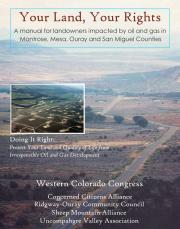
Download a pdf version of Your Land, Your Rights for Garfield, Delta and Rio Blanco Counties. Call 970-256-7650 to request a copy of the version for Montrose, Mesa, Ouray and San Miguel Counties. Click here for a sample Surface Use Agreement with a supplemental Exhibit between a surface landowner and an owner of underlying mineral rights. |
Western Colorado Congress is an alliance for community action empowering people |
to protect and enhance their quality of life in western Colorado. |
PO Box 1931, Grand Junction, CO 81502; phone (970) 256-7650; fax (970) 245-0686 |
| � |